EU labor costs are high – but Europe is not one cost location
European manufacturing is under cost pressure.
Labour costs are high, energy costs remain important, investment decisions are becoming more difficult and global competition continues to increase.
For many manufacturers, this creates an apparently simple choice:
Keep production in a high-cost European location – or move manufacturing to a lower-cost region outside Europe.
But this view misses an important point.
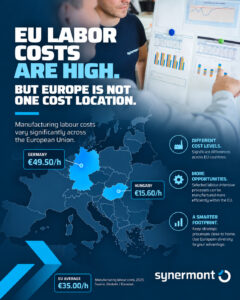
Europe itself contains very different manufacturing cost structures.
For some production processes, these differences can create another strategic option.
Manufacturing labour costs vary significantly across Europe
According to calculations by the German Federal Statistical Office based on Eurostat data, manufacturing labour costs in 2025 varied considerably across the European Union.
Germany: €49.50/hour
Austria: €51.30/hour
EU average: €35.00/hour
Czech Republic: €20.20/hour
Poland: €17.10/hour
Hungary: €15.60/hour
Romania: €12.00/hour
Bulgaria: €10.20/hour
These figures refer specifically to labour costs per hour worked in manufacturing – NACE C.
They show that talking about a single “European manufacturing cost” can be misleading.
The cost structure of manufacturing in Germany is very different from the cost structure in Hungary, Poland, the Czech Republic or Romania.
Germany is around 41% above the EU manufacturing average
German manufacturing labour costs of €49.50/hour were approximately 41% above the EU manufacturing average of €35.00/hour in 2025.
The difference compared with some Central and Eastern European manufacturing locations is even greater.
Hungarian manufacturing labour costs were €15.60/hour.
This means that the German figure was more than three times the Hungarian level.
But this comparison requires an important qualification.
It does not mean that manufacturing a product in Hungary is automatically three times cheaper.
Labour cost is only one component of manufacturing cost.
And manufacturing cost itself is only one component of the total cost of supplying a product.
Labour intensity determines how much the difference matters
Consider two different production processes.
The first is highly automated.
Machines perform most of the production work. Labour represents only a small share of the total cost.
Moving this process to a lower-labour-cost location may have relatively little economic impact.
Now consider a second process.
It requires:
- manual assembly
- handling
- inspection
- testing
- rework
- packaging
- several operator hours per production batch
In this case, labour represents a much larger part of the manufacturing cost.
The location of the process therefore matters much more.
This leads to an important manufacturing strategy principle:
Different production processes require different location strategies.
Not every process needs the same manufacturing location
A manufacturing company may have strong reasons to keep certain processes close to its headquarters.
These can include:
- proprietary technology
- engineering-intensive production
- product development
- strategic know-how
- highly automated processes
- sensitive intellectual property
- critical quality capabilities
But the same argument may not apply equally to every production step.
Manual assembly, pre-assembly, testing, packaging or other labour-intensive processes can have very different strategic characteristics.
Instead of asking whether an entire product should be manufactured in Germany, Hungary or Asia, companies can ask a more precise question:
Which production process belongs in which location?
Europe or Asia does not have to be a binary decision
Asia can offer very competitive direct manufacturing costs.
For high-volume products, mature supply chains and certain technologies, Asian production can be economically attractive.
But direct manufacturing cost is not the same as total cost.
Companies sourcing from distant production locations may also need to consider:
- international freight
- longer lead times
- higher inventory levels
- working capital
- minimum order quantities
- quality management
- supplier coordination
- travel
- communication
- time-zone differences
- supply-chain disruption
- geopolitical exposure
None of these factors automatically makes European production more competitive.
But they need to be included in the decision.
The correct comparison is therefore not simply:
€ per labour hour.
It is:
total cost and total business impact.
Total landed cost provides a better comparison
A supplier quotation gives an important number.
But it does not necessarily show the complete economic impact of the sourcing decision.
A broader total-cost analysis can include:
Direct manufacturing cost
plus
Logistics
plus
Inventory
plus
Quality management
plus
Working capital
plus
Coordination
plus
Supply-chain risk
plus
cost of inflexibility.
For some products, Asia will still provide the strongest business case.
For others, the difference becomes considerably smaller when these additional factors are included.
And this is where different European manufacturing locations become particularly interesting.
A differentiated European manufacturing footprint
European manufacturers do not necessarily have to choose between keeping everything at home and moving everything outside Europe.
There is another option.
Companies can create a manufacturing network where different production locations perform different roles.
For example:
Germany or Austria
Engineering
Product development
Automation
Strategic know-how
Core technologies
Central or Eastern Europe
Manual assembly
Pre-assembly
Electronics assembly
Testing
Rework
Packaging
Flexible additional capacity
This is not about moving the entire factory.
It is about allocating manufacturing processes more intelligently.
Why EU-based outsourcing can be attractive
Using a contract manufacturing partner within the European Union can combine different advantages.
Depending on the project, these can include:
- lower labour-cost structures
- geographical proximity
- shorter transport distances
- European regulatory environment
- easier communication
- shorter lead times
- smaller production batches
- greater flexibility
- reduced need for internal capacity investment
The objective is not necessarily to achieve the lowest possible hourly production cost.
The objective is to create the best overall manufacturing structure.
Hungary as part of a European manufacturing network
Hungary represents one example of this European cost differentiation.
According to Destatis/Eurostat data, manufacturing labour costs in Hungary were €15.60/hour in 2025 compared with €49.50/hour in Germany.
At the same time, Hungary operates within the European Union and is geographically close to the German and Austrian industrial markets.
This creates an interesting environment for selected labour-intensive manufacturing processes.
At Synermont, we support European manufacturers from Hungary with activities including:
- product assembly
- electronics assembly
- pre-assembly
- testing
- inspection
- rework
- packaging
- production support
- ramp-up
The objective is not to replace the customer’s core manufacturing capabilities.
It is to complement them.
Cost optimization does not always require leaving Europe
European manufacturing faces a real cost challenge.
Ignoring that challenge is not a strategy.
But neither is assuming that the only alternative is moving manufacturing thousands of kilometres away.
Europe contains very different cost structures, manufacturing capabilities and production environments.
For labour-intensive production processes, these differences can create meaningful opportunities.
The key is to evaluate manufacturing at process level rather than factory level.
Keep the processes that create strategic value where they belong.
Evaluate labour-intensive and transferable processes separately.
Compare total cost rather than only supplier price.
And then choose the manufacturing location that creates the strongest overall business case.
Sometimes cost optimization does not require leaving Europe.
-> Read more about our services

