What I learned from a summer inside German manufacturing
Five observations from customer visits, industry events and conversations with German manufacturers in 2026
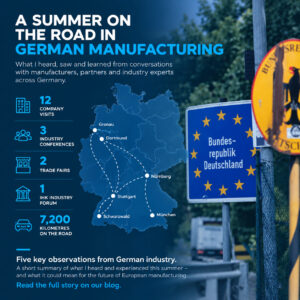
I spent a significant part of this summer travelling across Germany.
Some trips were to existing customers. Others were meetings with potential partners. I also attended manufacturing-related conferences, industry forums, trade fairs and events organized by German Chambers of Industry and Commerce.
From the Dortmund and Gronau regions to the Schwarzwald, Stuttgart and Munich, I had the opportunity to speak with people working directly in German manufacturing.
These conversations were obviously not a scientific survey of German industry.
But after hearing similar topics repeatedly in very different environments, several patterns became difficult to ignore.
These are my personal observations from that summer.
- The Confidence Around German Manufacturing Is Changing
My strongest impression was not that German industry has suddenly become pessimistic.
It was something more subtle.
There are more questions.
For decades, German manufacturing operated with a remarkable level of industrial confidence. German Engineering, German automotive technology, industrial machinery and manufacturing quality were global benchmarks.
That capability has not disappeared.
But the conversations today increasingly include questions about competitiveness, investment, labour costs, energy, international competition and future production strategies.
Current economic indicators reflect some of this uncertainty. Business sentiment has shown signs of improvement during 2026, but manufacturing companies continue to face pressure from weak orders and structural cost challenges.
The feeling is therefore not simply one of decline.
It is a feeling of transition.
- Manufacturing Cost Pressure Is Becoming Structural
Another recurring topic was cost.
But describing the situation simply as a “high-cost problem” would be misleading.
German manufacturers face several pressures simultaneously:
labour costs, energy, investment requirements, regulation, international competition and changing global supply chains.
This makes the manufacturing question more complex.
The answer cannot simply be to find the cheapest possible supplier.
Instead, companies increasingly need to ask a more strategic question:
Which manufacturing processes really need to remain in-house – and which can be organized differently?
Core technologies, engineering know-how and strategically critical processes should remain where they create the most value.
But labour-intensive, scalable or capacity-sensitive processes may sometimes be organized more efficiently through a broader European manufacturing network.
Competitiveness may therefore increasingly depend on manufacturing architecture, not only manufacturing productivity.
- Is German Engineering Becoming Too Complex?
This was perhaps the most interesting question I encountered.
German Engineering remains an enormous competitive advantage.
Technical depth, quality standards, process discipline and engineering expertise are among the reasons why German industrial companies have been globally successful for decades.
But I increasingly hear another question:
When does engineering excellence become too much complexity?
This does not mean that companies should lower quality standards or abandon engineering discipline.
The issue is speed.
Global competitors are becoming faster at developing products, industrializing them and bringing them to market.
In this environment, simplicity and speed may become competitive advantages alongside technical excellence.
The question for German manufacturing may therefore not be whether it needs less engineering.
A better question could be:
How can German Engineering remain excellent while becoming faster and more flexible?
- China Is No Longer Only a Low-Cost Competitor
The perception of China has also changed significantly.
Fifteen or twenty years ago, China was often discussed primarily as a low-cost manufacturing location.
Today that description is no longer sufficient.
Chinese industrial companies increasingly compete through a combination of:
technology, speed, scale and cost.
Recent DIHK research confirms that German companies are increasingly experiencing competitive pressure from China, particularly in industrial markets.
This changes the strategic question for European manufacturers.
It is no longer enough to ask:
How can Europe compete with Chinese manufacturing costs?
The more important question may be:
How can Europe combine its engineering expertise with greater speed, flexibility and cost competitiveness?
That is a fundamentally different challenge.
- The Automotive Industry Shows How Deep the Transformation Is
Few industries represent German industrial strength as clearly as automotive manufacturing.
For decades, German automotive companies set global benchmarks in engineering, quality, manufacturing technology and innovation.
Germany remains one of the world’s most important automotive and electric-vehicle manufacturing locations.
But the competitive environment has changed.
Electrification, software, new Chinese competitors and changing global markets have created a different technological landscape.
German automotive engineering has not disappeared.
But German manufacturers no longer operate from an unquestioned position of technological leadership in every area.
That difference matters.
It forces companies to adapt faster while simultaneously managing significant cost and investment pressure.
In many ways, automotive manufacturing represents the broader transformation taking place across German industry.
What Could Come Next?
Despite these challenges, I did not return from these trips believing that German manufacturing has lost its future.
Quite the opposite.
Germany still possesses extraordinary engineering expertise, industrial infrastructure, manufacturing know-how and globally respected companies.
The question is how these strengths should be organized for the next phase of global competition.
Perhaps Germany does not need to become the cheapest manufacturing location.
Perhaps it needs to become more flexible.
A future European manufacturing model could combine German engineering, product know-how and strategic technologies with flexible manufacturing capacity across competitive European locations.
That does not mean outsourcing everything.
And it certainly does not mean giving up control over strategic manufacturing knowledge.
It means deciding more carefully where different activities create the most value.
Keep strategic competencies where they belong. Organize other manufacturing processes where they can be operated most effectively.
After a summer of conversations across German manufacturing, this may be the observation I consider most important:
The next chapter of European industrial competitiveness may depend not only on better engineering or lower costs – but on building more flexible manufacturing structures around both.
-> Read more about our services

