Understanding the German manufacturing market: Why listening comes before selling
If you want to understand a market, you have to spend time in the market.
This sounds simple.
But for companies working internationally, it is an important principle.
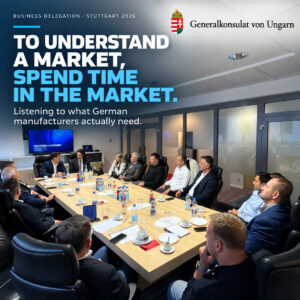
During a recent Hungarian business delegation to Stuttgart, I had the opportunity to participate in discussions with companies, economic institutions and representatives working closely with the German market.
One of our meetings took place at the Consulate General of Hungary in Stuttgart.
The discussions covered the current economic environment, German–Hungarian business relations and the opportunities ahead for companies working between the two countries.
For me, however, the most important takeaway was not a single statistic or presentation.
It was a reminder of a question we continuously have to ask ourselves at Synermont:
What do German manufacturers actually need?
Not what do we want to sell them.
Not which service do we want to promote.
But what problems are they trying to solve?
That difference matters.
German Manufacturing Is Operating in a More Uncertain Environment
It would be difficult to discuss the German market in 2026 without acknowledging the uncertainty surrounding the economy.
German companies are facing pressure from several directions.
Energy and raw-material prices, labour costs, domestic demand and the broader economic-policy environment all remain significant business concerns.
The DIHK Economic Survey for early summer 2026 illustrates this uncertainty clearly.
More than 23,000 companies from almost all sectors and regions participated. Only 13% expected their business situation to improve over the following twelve months, while 33% expected it to deteriorate. The DIHK also reduced its 2026 growth forecast to just 0.3%. dihk.de
The same survey shows the breadth of the pressure: 70% of participating companies identified energy and raw-material prices as a business risk, 58% cited economic-policy conditions, 57% labour costs and 56% weak domestic demand. dihk.de
This does not mean that German manufacturing is standing still.
Quite the opposite.
Pressure creates an even stronger reason to reconsider how companies organize production, investment and capacity.
At the Same Time, Germany Is Preparing for Major Investment
The other side of the story is equally important.
Germany is not only discussing its structural challenges. It has also launched a major long-term investment programme.
The German government’s Special Fund for Infrastructure and Climate Neutrality provides borrowing authorization for investments totalling €500 billion. Investments can be approved over a twelve-year period from 2025 to 2036, in addition to investments financed through the regular federal budget. Bundesministerium der Finanzen
Priority areas include transport infrastructure, education, digitalisation, housing and energy infrastructure. The government explicitly connects the programme with modernization, strengthening economic conditions and supporting Germany’s future competitiveness. Bundesministerium der Finanzen
The programme is already moving from planning into implementation: according to the Federal Ministry of Finance, €24 billion was disbursed from the special fund in 2025. Bundesministerium der Finanzen
For companies working with the German market, this creates an interesting situation.
There is uncertainty – but there is also investment.
There is cost pressure – but there is also transformation.
There are concerns about competitiveness – but also significant resources being committed to modernization.
That combination is important for manufacturing partners to understand.
What Do German Manufacturers Actually Need?
For an external manufacturing partner, the wrong reaction would be to look at Germany’s cost pressure and conclude:
German companies simply need cheaper production.
The reality is more complex.
Cost matters.
But manufacturing decisions are rarely based on labour cost alone.
German manufacturers also have to think about:
- production capacity,
- flexibility,
- quality,
- supply-chain resilience,
- investment requirements,
- workforce availability,
- industrialization,
- logistics,
- transparency,
- and control.
The right question is therefore not simply:
Where can we manufacture cheaper?
It is:
How can we build a manufacturing structure that remains competitive, flexible and reliable?
This is exactly why understanding the market comes before building the offer.
German–Hungarian Industrial Cooperation Has a Strong Foundation
Another important message from our discussions in Stuttgart was the strength of existing German–Hungarian business relationships.
Hungary is not a new or unknown industrial location for German companies.
There is already a long history of cooperation between German and Hungarian businesses, particularly in manufacturing and industrial supply chains.
An important message we heard during the Stuttgart discussions was that Hungarian companies can build on an existing level of trust.
Professionalism, technical competence and reliability were highlighted in the discussions as important foundations of established German–Hungarian industrial relationships.
This distinction is important: this observation reflects the professional discussions during our Stuttgart visit rather than a statistical claim about every German company.
Nevertheless, the practical implication is relevant.
For Hungarian manufacturing companies, the opportunity is not necessarily to convince German companies that industrial cooperation with Hungary is possible.
In many cases, that experience already exists.
The challenge is to demonstrate how the next generation of German–Hungarian manufacturing cooperation can create additional value.
From Supplier to Manufacturing Partner
This distinction is becoming increasingly important.
A traditional supplier relationship is often relatively simple:
Drawing → Quotation → Production → Delivery
A strategic manufacturing partnership goes further.
It can include:
- production transfer,
- industrialization,
- production engineering,
- workforce management,
- quality systems,
- testing,
- logistics,
- ramp-up,
- flexible capacity,
- and continuous process development.
This changes the discussion.
The question is no longer only:
Who can produce this component at the lowest price?
It becomes:
Which manufacturing structure creates the best overall business case?
For some products, the answer will remain fully in-house production.
For others, global sourcing will make sense.
But for labour-intensive, capacity-sensitive or scalable production processes, a flexible European manufacturing network can provide another option.
Listen First. Then Build the Manufacturing Model.
This is perhaps the most important lesson for us at Synermont.
We should not expect German manufacturers to adapt to our manufacturing model.
Our manufacturing model has to evolve around what our customers actually need.
That means spending time in the market.
Visiting customers.
Talking to production managers.
Listening to procurement teams.
Meeting industry organizations.
Understanding what is changing inside German manufacturing companies.
And then asking:
Where is the real problem?
Is it cost?
Capacity?
Labour availability?
CAPEX?
Ramp-up?
Flexibility?
Supply-chain risk?
Or simply the need to focus internal resources on more strategic processes?
Only after understanding the problem should we define the solution.
The Opportunity Is Not Simply “Lower-Cost Manufacturing”
For Central European manufacturing partners, it can be tempting to position everything around cost.
Hungary does have a different manufacturing cost structure from Germany.
But cost alone is not a sustainable positioning.
The stronger opportunity is to combine several advantages:
European location.
Competitive manufacturing structure.
Industrial know-how.
Flexible capacity.
Shorter and more transparent supply chains.
Close cooperation with the customer.
This is where concepts such as contract manufacturing and the Extended Workbench – or Verlängerte Werkbank – become relevant.
The objective is not maximum outsourcing.
It is to determine which processes should remain inside the customer’s organization and which can be operated more efficiently by a manufacturing partner.
Understanding Comes Before Selling
Germany remains one of Europe’s central industrial markets.
But it is also a market undergoing significant change.
Economic uncertainty, cost pressure and international competition are forcing companies to reconsider established structures. Current DIHK data shows that expectations, investment intentions and employment plans remain under considerable pressure. dihk.de
At the same time, Germany’s €500 billion infrastructure and modernization programme demonstrates the scale of the investment being mobilized for the coming decade. Bundesministerium der Finanzen
For manufacturing partners, this creates both responsibility and opportunity.
The objective should not be to arrive with a predefined solution and try to convince the market to buy it.
The better approach is much simpler:
Listen first. Understand the problem. Then build the right manufacturing model around it.
That is why spending time in the market matters.
And that is why conversations like those we had in Stuttgart are valuable to us.
They help us understand not only where the German manufacturing market is today – but also what our customers may need from us tomorrow.
-> Read more about our services

