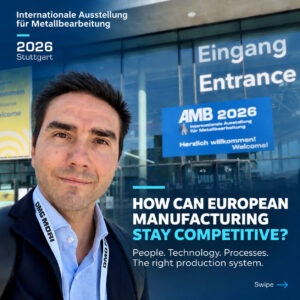
How can European manufacturing stay competitive? Building the right production system
European manufacturing is facing a difficult question:
How can manufacturers remain competitive with limited people, high costs and increasing global pressure?
This question was on my mind during my visit to AMB Stuttgart 2026.
Walking through the exhibition halls, the speed of technological development was impossible to miss.
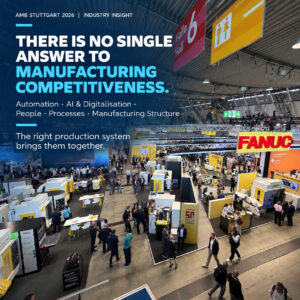
Automation. Artificial intelligence. Digitalisation. Advanced machine tools. Quality systems. Connected production.
These technologies are changing how products are manufactured.
But they also reinforce a broader lesson:
There is no single technology that makes a manufacturing company competitive.
Manufacturing competitiveness comes from building the right production system.
What AMB Stuttgart 2026 Shows About the Future of Manufacturing
AMB is one of the major international exhibitions for metalworking and manufacturing technology.
The 2026 exhibition takes place across more than 120,000 square metres at Messe Stuttgart. Its exhibition areas include machine tools and manufacturing systems, precision tools, measurement and quality assurance, software and digitalisation, and automation and handling technology. Messe Stuttgart
The topics highlighted around AMB 2026 also show where manufacturing technology is heading.
Artificial intelligence in manufacturing, automation, collaborative processes, digitalisation and sustainability are among the themes receiving particular attention. Messe Stuttgart
These are not simply technology trends.
They are responses to real manufacturing problems.
Companies need higher productivity.
They need reliable quality.
They need flexibility.
They need to manage labour availability.
And they need to remain competitive internationally.
Why European Manufacturing Competitiveness Is Under Pressure
The technology cannot be separated from the economic environment.
German manufacturing companies in particular are operating under significant pressure.
According to the DIHK Economic Survey from early summer 2026, labour costs remain a business risk for 60% of German industrial companies.
At the same time, the number of people employed in German manufacturing has fallen by approximately half a million since 2019. The same survey reports that only 11% of industrial companies expected to increase employment, while 31% planned workforce reductions. dihk.de
The labour situation is complex.
A weak economy currently reduces recruitment demand, but Germany’s demographic challenge has not disappeared. The DIHK Skilled Labour Report 2025/2026 found that 36% of surveyed companies were still at least partly unable to fill vacancies with suitable workers. dihk.de
For manufacturing companies, this creates a difficult combination:
cost pressure + productivity pressure + demographic pressure + global competition.
That is why manufacturing productivity is becoming strategically important.
Automation Is an Important Part of the Answer
Automation is one of the most important tools available to manufacturers.
Modern automation can:
- increase productivity,
- improve repeatability,
- reduce manual handling,
- improve quality,
- reduce dependence on difficult-to-fill positions,
- increase process stability,
- and support scalable production.
AMB 2026 itself places automation and handling technology among its central exhibition areas. Messe Stuttgart
For processes that are stable, repetitive and technically suitable, automation can create a strong business case.
But the decision should begin with the manufacturing process – not with the technology.
The relevant question is:
Where does automation create the greatest operational and economic value?
AI and Digitalisation Are Changing Manufacturing Too
Artificial intelligence is moving from experimentation toward practical manufacturing applications.
AMB 2026 explicitly identifies AI in manufacturing as one of its focus areas, alongside broader software and digitalisation technologies. Messe Stuttgart
Potential applications include:
- process monitoring,
- predictive maintenance,
- quality analysis,
- production planning,
- machine optimization,
- data analysis,
- and decision support.
Digitalisation can also create something equally important:
visibility.
A production system becomes easier to manage when companies have better information about:
- output,
- quality,
- downtime,
- capacity,
- material flow,
- bottlenecks,
- and process performance.
Technology therefore becomes not only a production tool but also a management tool.
But Manufacturing Is More Than Technology
This is where the discussion becomes more interesting.
A factory is a system.
Technology is one part of that system.
But so are:
People.
Processes.
Layout.
Material flow.
Quality.
Capacity.
Logistics.
Location.
Suppliers and manufacturing partners.
A highly automated machine does not automatically solve a poorly designed process.
Digitalisation does not automatically solve a capacity problem.
Additional employees do not automatically solve an inefficient production layout.
And outsourcing does not automatically solve a cost problem.
Each tool solves a different problem.
That is why manufacturing strategy needs to start with the complete system.
What Is the Right Production System?
There is no universal definition.
The right production system depends on:
- the product,
- production volume,
- process complexity,
- labour content,
- quality requirements,
- required flexibility,
- investment requirements,
- available workforce,
- logistics,
- and strategic importance of the process.
For one product, the right solution may be highly automated in-house production.
For another, it may be a combination of automation and manual assembly.
For another, selected labour-intensive processes may be operated by an external manufacturing partner.
And in some cases, a hybrid manufacturing structure can provide the best balance.
The important point is:
The production system should be designed around the business requirement – not the other way around.
People Still Matter in Modern Manufacturing
The increasing role of automation and AI does not mean people disappear from manufacturing.
Their role changes.
People remain essential for:
- engineering,
- industrialization,
- process development,
- quality management,
- maintenance,
- problem solving,
- complex assembly,
- flexible production,
- and continuous improvement.
For many manufacturing processes, the most competitive structure will therefore not be “people or automation”.
It will be:
the right combination of people and technology.
This is particularly relevant for high-mix, variable-volume or complex assembly environments where full automation may not always create the strongest business case.
Manufacturing Structure Is Another Part of the Equation
Manufacturing competitiveness is also influenced by where and how production is organized.
German manufacturers are already reconsidering international manufacturing structures.
A 2026 DIHK analysis of 1,700 industrial companies with foreign operations found that 43% planned foreign investment in 2026. For the third consecutive year, cost savings were the dominant motive for foreign investment. dihk.de
This does not mean that production simply moves to the lowest-cost country.
Manufacturing location decisions involve much more:
- logistics,
- quality,
- lead times,
- supply-chain risk,
- available skills,
- communication,
- investment,
- flexibility,
- and control.
For some production processes, a European manufacturing network can offer an alternative between expensive fully in-house production and distant global sourcing.
Where Contract Manufacturing Can Fit Into the Production System
Contract manufacturing should therefore not be viewed as an alternative to technology.
It is another element of manufacturing strategy.
A company can automate strategic high-volume processes internally while outsourcing selected labour-intensive processes.
It can retain engineering and product know-how while using external production capacity.
It can operate core manufacturing internally while using a manufacturing partner to handle demand peaks or additional product families.
This is the logic behind models such as the Extended Workbench – or Verlängerte Werkbank.
The customer retains strategic control and core know-how while clearly defined operational production responsibilities can be handled by a manufacturing partner.
The objective is not maximum outsourcing.
The objective is:
the right allocation of technology, people, capital and production responsibility.
Flexibility Is Becoming a Manufacturing Capability
Manufacturing companies traditionally optimize for:
- cost,
- quality,
- output,
- and efficiency.
Increasing uncertainty adds another important variable:
flexibility.
Companies may need to respond quickly to:
- changing demand,
- new products,
- shorter product life cycles,
- supply-chain disruption,
- workforce constraints,
- or changing customer requirements.
A production system that is highly efficient but extremely rigid may therefore not always create the strongest overall business case.
The ability to scale, adapt and reallocate capacity is increasingly valuable.
Building the Right Production System
There is no single answer to European manufacturing competitiveness.
The answer will differ by company, product and process.
But the strategic framework can remain consistent.
Manufacturers should ask:
Which processes are strategic?
Which processes should remain in-house?
Where can automation create the strongest return?
Where can AI or digitalisation improve productivity and transparency?
Where is skilled human work still the most effective solution?
Where is additional flexible capacity required?
Which processes could be handled by a manufacturing partner?
What manufacturing footprint creates the best overall business case?
These questions should be answered together.
Because they are all parts of the same production system.
Why Spending Time at AMB Matters
For me, this is also why events such as AMB Stuttgart matter.
Not because attending an exhibition is an achievement.
And not because every new technology presented there should immediately be implemented.
The value is understanding how manufacturing is evolving.
Seeing technologies directly.
Speaking with companies developing them.
Understanding which problems they are trying to solve.
And continuously challenging our own assumptions about production.
At Synermont, this is particularly relevant because our role as a contract manufacturing partner is not simply to provide production capacity.
We need to understand how our customers’ manufacturing environments are changing.
Only then can we continuously develop our own processes, capabilities and manufacturing model around what the market actually needs.
The Future of Manufacturing Is a System
Automation will continue to develop.
AI will become more important.
Factories will become more connected.
Production data will become more valuable.
And manufacturing processes will continue to evolve.
But competitiveness will not come from one technology alone.
It will come from combining:
Technology. People. Processes. Capacity. Manufacturing structure.
in the right way.
That is the real challenge.
And ultimately:
Manufacturing competitiveness is about building the right production system.
-> Read more about our services

