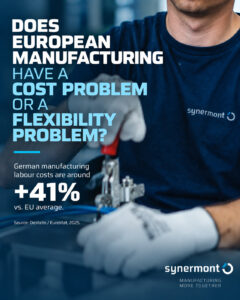
Does European manufacturing have a cost problem or a flexibility problem?
European manufacturers are under significant cost pressure.
For German industry in particular, labour costs are one of the most visible challenges. According to the German Federal Statistical Office, manufacturing labour costs in Germany reached €49.50 per hour in 2025, compared with an EU average of €35.00.
That is a difference of more than 40%.
The concern is also visible in industry surveys. In the DIHK Economic Survey from early summer 2026, 60% of German industrial companies identified labour costs as a business risk.
The cost problem is therefore real.
But there is another question worth asking:
Does European manufacturing only have a cost problem – or does it also have a flexibility problem?
High labour costs are only part of the equation
Manufacturing cost is much more than the hourly cost of an employee.
Companies also need to consider facilities, equipment, energy, management, quality, maintenance, logistics, inventory and the cost of unused capacity.
This becomes particularly important when production demand changes.
A manufacturing company may need enough people, space and equipment to manage peak demand. But when volumes fall, much of this capacity remains as fixed cost.
The result is a structural challenge.
The company needs enough capacity to grow and react to customer demand, but maintaining that capacity internally can become expensive when it is not continuously utilized.
This is where flexibility becomes part of the cost discussion.
Not every manufacturing process needs the same strategy
The solution is not simply to outsource production because labour costs are lower somewhere else.
Manufacturing companies should first distinguish between different types of processes.
Some capabilities are strategically important and should normally remain internal.
These may include product development, intellectual property, engineering know-how, proprietary technologies, highly specialized manufacturing processes or operations that directly create competitive differentiation.
These are core competencies.
But other manufacturing processes may have a different strategic role.
Manual assembly, pre-assembly, electronics assembly, testing, packaging, rework and other labour-intensive operations can often require significant capacity without necessarily representing the company’s core know-how.
For these processes, a different production model may be worth evaluating.
From fixed capacity to flexible capacity
Traditional in-house production converts much of manufacturing capacity into fixed infrastructure.
Employees need to be hired. Production areas need to be available. Equipment may need to be purchased. Supervisory and support structures need to be created.
This model can work extremely well when demand is predictable and capacity is continuously utilized.
The challenge appears when demand is volatile.
If production volumes increase temporarily, internal capacity may become insufficient.
If companies invest for peak demand and volumes later decrease, they may be left with underutilized capacity.
Contract manufacturing offers another option.
Selected manufacturing processes can be transferred to an external production partner, allowing part of the manufacturing capacity to become more flexible.
The objective is not necessarily to replace internal production.
It is to complement it.
European manufacturing has very different cost structures
One important characteristic of Europe is that manufacturing cost structures vary significantly between countries.
In 2025, labour costs in German manufacturing averaged €49.50 per hour. The EU manufacturing average was €35.00.
In Hungary, the corresponding figure was €15.60.
These differences do not mean that the cheapest location automatically provides the lowest total production cost.
Productivity, quality, logistics, management, automation, communication, process stability and many other factors must also be considered.
But the differences demonstrate something important:
European manufacturers can create different cost structures without leaving Europe.
For German and Austrian manufacturers, this creates the possibility of combining high-value core capabilities at the home location with selected production processes in other EU manufacturing regions.
Outsourcing should not be based on hourly labour cost alone
A make-or-buy decision should never be reduced to a comparison between two hourly rates.
The correct question is total cost.
Companies should consider:
- internal labour and overhead costs
- required production area
- equipment and investment
- capacity utilization
- quality costs
- logistics
- inventory
- management resources
- production ramp-up
- demand volatility
- supply-chain risk
- process transfer costs
A lower hourly labour rate is only valuable if the complete production system remains efficient, reliable and manageable.
This is why choosing the right manufacturing partner is more important than simply choosing the lowest-cost location.
Which processes can be suitable for outsourcing?
There is no universal answer.
However, certain characteristics can indicate that a process is worth evaluating for external manufacturing.
A process may be a suitable candidate when it is labour-intensive, scalable, relatively easy to transfer, subject to fluctuating demand or not strategically differentiating.
Processes such as product assembly, electronics assembly, testing, packaging, rework or selected production support activities can often fall into this category.
The final decision depends on the product, process, volume, quality requirements and the company’s manufacturing strategy.
Keep the core. Make the capacity flexible.
For many European manufacturers, the optimal production model will probably not be 100% in-house manufacturing or 100% outsourcing.
The more interesting model lies somewhere between the two.
Strategic know-how and core competencies remain internal.
Selected manufacturing processes can be performed by qualified external partners.
This allows manufacturers to create additional capacity without automatically creating the same level of permanent infrastructure and fixed cost.
At Synermont, this is the principle behind our approach to contract manufacturing.
From our manufacturing locations in Hungary, we support European companies with outsourced production processes including product assembly, electronics assembly, production support, testing, packaging and production ramp-up.
The objective is not simply to provide lower-cost labour.
It is to integrate flexible manufacturing capacity into the customer’s existing production structure.
European manufacturing undoubtedly faces a cost challenge.
But solving that challenge may require more than reducing individual cost items.
Sometimes the more important question is how much of the manufacturing structure really needs to remain fixed.
Statistical claims in the article are based on Destatis/Eurostat and DIHK 2026 data. Statisztikai Szolgálat
->Read more about our services

