European manufacturing doesn’t have to be the cheapest – It has to create the best business case
European manufacturing often faces a difficult comparison.
A supplier from a distant low-cost manufacturing region may offer a significantly lower unit price than a European supplier.
From a purchasing perspective, the conclusion can initially look simple.
If one supplier offers the same product for less, why pay more?
Unit price matters.
But it is only one part of the manufacturing decision.
The complete business case can also include logistics, inventory, working capital, lead time, time-to-market, quality management, flexibility, supplier coordination and supply-chain risk.
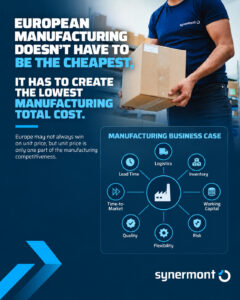
For some products, global sourcing will still create the strongest overall business case.
For others, the calculation can change significantly once these additional factors are included.
The real question is therefore not:
Where can we buy the product at the lowest unit price?
It is:
Which manufacturing structure creates the best overall business case?
Unit price is visible – many other costs are not
Supplier quotations make direct price comparison easy.
Supplier A offers €8.50 per unit.
Supplier B offers €9.20.
The difference is immediately visible.
Other costs are less visible.
How much inventory will each sourcing model require?
How long is the lead time?
How much capital will be tied up?
How quickly can production volumes change?
How quickly can an engineering change be implemented?
How much management effort will supplier coordination require?
How quickly can a new product reach the market?
These questions do not always appear in the supplier quotation.
But they can influence the economics of the sourcing decision.
Logistics
Distance creates logistics requirements.
Depending on the sourcing model, this can include longer transportation routes, international freight, additional handling and greater transport complexity.
For stable, high-volume products, these costs may be predictable and manageable.
For frequently changing products or smaller production volumes, they may become more important.
The key is to include logistics in the business case rather than evaluating supplier price independently.
Inventory
Longer supply chains often require additional inventory.
Companies may need more:
- safety stock
- goods in transit
- buffer inventory
- finished goods
- components
Inventory provides supply security.
But inventory also has a cost.
It requires space, planning and capital.
A lower unit price can therefore create savings in purchasing while increasing cost elsewhere in the manufacturing system.
Working capital
Inventory and long transportation times also affect working capital.
Capital tied up in materials, production, transport or stock cannot simultaneously be used elsewhere in the business.
This becomes particularly important when interest rates, cash flow or growth investment place pressure on company finances.
Working capital should therefore be considered when comparing sourcing alternatives.
Lead time
Lead time affects more than logistics planning.
Long lead times require companies to forecast demand further into the future.
The further ahead the forecast, the greater the potential uncertainty.
If actual demand differs from the forecast, companies may face:
- excess inventory
- shortages
- urgent transport
- delayed deliveries
- production rescheduling
Shorter lead times can therefore create operational flexibility.
Time-to-market
Time-to-market is particularly important for new and changing products.
Consider a company preparing a new product launch.
If production industrialization, pilot manufacturing and ramp-up can be completed faster, the product may reach customers earlier.
Earlier market entry can mean:
- earlier revenue
- faster customer feedback
- faster product iteration
- faster reaction to market demand
- reduced delay between development and commercialization
This means that time-to-market is not simply an operational KPI.
It can have direct business value.
The effect is especially relevant for:
- hardware products
- new product introduction
- product variants
- short product life cycles
- seasonal products
- prototype-to-series projects
- fast production ramp-ups
In these situations, supplier speed and responsiveness can become part of the commercial business case.
Quality management
Quality has both direct and indirect costs.
A quality problem can require:
- additional inspection
- sorting
- rework
- replacement production
- transport
- supplier audits
- engineering involvement
- management attention
Distance does not automatically mean lower quality.
European proximity does not automatically guarantee higher quality.
But the ability to communicate quickly, visit production, analyze problems together and implement corrective actions can influence the cost and speed of quality management.
Flexibility
A supplier may have an excellent price at a fixed annual volume.
But what happens when demand changes?
Can production increase quickly?
Can volumes decrease without creating excessive inventory?
Can batch sizes change?
Can product variants be introduced?
Can the manufacturing process adapt to engineering changes?
Flexibility has particular value when demand is uncertain.
And in many modern manufacturing environments, uncertainty is increasingly normal.
Engineering changes
Products rarely remain completely unchanged throughout their life cycle.
Components change.
Designs improve.
Customer requirements evolve.
Quality improvements are implemented.
Regulatory requirements may change.
Each engineering change has to move from drawing or specification into physical production.
The speed of this process can influence both cost and time-to-market.
For products requiring frequent technical interaction, proximity between customer and manufacturing partner can therefore have additional value.
Communication and coordination
Supplier management requires resources.
Meetings.
Quality discussions.
Production planning.
Forecasting.
Technical clarification.
Audits.
Visits.
Problem solving.
The effort required to coordinate the manufacturing relationship should also be considered.
This does not mean that geographically distant suppliers are necessarily difficult to manage.
Many global supply chains operate extremely efficiently.
The point is simply that coordination has a cost and should be part of the sourcing model.
Supply-chain risk
The last few years have made supply-chain risk significantly more visible.
Possible risks can include:
- transportation disruption
- geopolitical instability
- supplier concentration
- port congestion
- trade restrictions
- component shortages
- unexpected demand changes
Risk is difficult to convert into a simple cost-per-unit figure.
But it still has economic value.
A robust sourcing strategy therefore considers not only expected cost, but also what happens when the expected scenario changes.
When global sourcing still makes sense
A balanced manufacturing strategy must acknowledge an important reality.
For many products, global sourcing remains the best solution.
This can be particularly true when:
- volumes are very high
- products are stable
- labour intensity is significant
- supply chains are mature
- demand is predictable
- Asian supplier ecosystems provide unique capabilities
- unit-cost differences are substantial
European manufacturing should not attempt to win every production project.
That is neither realistic nor economically sensible.
The objective is to identify the projects and processes where European manufacturing creates a strong total business case.
Where European manufacturing can create additional value
European manufacturing can become particularly interesting when a project requires:
- shorter lead times
- flexible volumes
- smaller batches
- rapid engineering changes
- close quality cooperation
- frequent technical communication
- fast industrialization
- fast ramp-up
- shorter time-to-market
In these situations, manufacturing proximity can become part of the economic value proposition.
The supplier may not necessarily offer the lowest direct price.
But the overall manufacturing system can still become competitive.
A European production network rather than one factory
European manufacturing also does not mean that every production process needs to remain at the customer’s own facility.
A manufacturer can retain strategic processes internally while using European contract manufacturing capacity for selected operations.
For example:
Internal / core manufacturing
Engineering
Product development
Proprietary technology
Critical know-how
Strategic production processes
External European manufacturing
Manual assembly
Pre-assembly
Electronics assembly
Testing
Inspection
Rework
Packaging
Flexible additional capacity
This creates a manufacturing network rather than a binary make-or-buy decision.
Synermont’s role
Synermont supports European manufacturing companies from Hungary with selected outsourced production processes.
Our manufacturing capabilities include product assembly, electronics assembly, testing, packaging, production support and production engineering/ramp-up.
The objective is not to replace the customer’s core manufacturing organization.
It is to complement it.
For some projects, the main advantage may be labour-cost structure.
For others, it may be capacity.
For others, flexibility.
For new products, it may be speed and time-to-market.
The correct solution depends on the manufacturing process and the customer’s business case.
Optimize the manufacturing system – not only the price
The lowest supplier price is an important advantage.
But it should not automatically be confused with the lowest total cost.
A strategic sourcing decision should consider the complete manufacturing system:
Unit price
plus
logistics
plus
inventory
plus
working capital
plus
lead time
plus
time-to-market
plus
quality
plus
flexibility
plus
risk.
For some products, the result will favour global sourcing.
For others, European manufacturing can become considerably more competitive once the complete business case is considered.
The objective is not to prove that Europe is always cheaper.
The objective is much simpler:
Don’t optimize only the unit price. Optimize the total manufacturing system.
-> Read more about our Services

