Extended Workbench Manufacturing: How to reduce costs Without losing control
European manufacturers face a difficult balance.
Production costs need to remain competitive. Capacity needs to become more flexible. Labour-intensive processes need to be organized efficiently.
At the same time, manufacturers do not want to lose control over their products, quality standards or production know-how.
This creates an important question:
How can manufacturers use the advantages of outsourced production without giving up strategic control?
One possible answer is the Extended Workbench model – commonly known in German-speaking manufacturing as the “Verlängerte Werkbank.”
More Than Traditional Outsourcing
Traditional outsourcing can sometimes create a clear separation between customer and supplier.
The customer defines the requirement. The supplier manufactures the product.
An Extended Workbench can create a more integrated relationship.
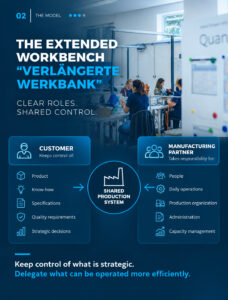
Instead of transferring complete responsibility for manufacturing, the customer and manufacturing partner define which competencies and responsibilities should remain on each side.
The objective is not maximum outsourcing.
It is the right allocation of responsibilities.
Keep Strategic Know-how Where It Belongs
Product knowledge, specifications, engineering decisions, quality requirements and critical technologies can remain under the customer’s control.
These are often core competencies that differentiate a manufacturer from its competitors.
There is little strategic value in outsourcing them simply because other production activities are being transferred.
At the same time, not every operational manufacturing activity needs to remain inside the customer’s own organization.
Labour-intensive assembly, selected electronics assembly, testing, packaging, rework or other production-support processes may be organized through an external manufacturing partner.
Clear Roles Create a Better Manufacturing Model
A successful Extended Workbench therefore requires clearly defined responsibilities.
The customer can retain responsibility for areas such as:
- product know-how
- specifications
- engineering requirements
- quality expectations
- strategic manufacturing decisions
The manufacturing partner can take responsibility for areas such as:
- production personnel
- daily production operations
- production organization
- operational administration
- flexible capacity
- defined manufacturing processes
The exact division will depend on the product, process and partnership.
The important point is that outsourcing does not automatically require the customer to give up control.
The Production Environment Can Become Part of the Partnership
The model can go further than simply transferring a manufacturing process into an existing factory.
When a production partnership is developed strategically, the production environment itself can be designed around the requirements of the process.
Material flow, workstations, equipment, quality points, storage, logistics and future capacity can all be considered during industrialization.
This is where customer know-how and manufacturing know-how become particularly valuable together.
The customer understands the product, its requirements and its history.
The manufacturing partner contributes experience in production processes, industrialization, workforce organization and daily operations.
Together, these competencies can create a production system designed for the actual manufacturing requirement.
Cost Optimization Without Leaving Europe
Location remains an important part of the business case.
For labour-intensive manufacturing processes, labour-cost differences within Europe can be significant.
However, hourly labour cost alone should not determine a manufacturing strategy.
Logistics, inventory, lead time, working capital, quality, flexibility, engineering communication, time-to-market and supply-chain risk also influence the total manufacturing business case.
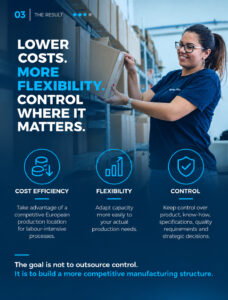
An Extended Workbench in a competitive EU manufacturing location can therefore provide an alternative to both high-cost in-house production and more distant global sourcing.
From Supplier to Manufacturing Partner
The most important difference may ultimately be the relationship itself.
A traditional supplier executes an order.
A strategic manufacturing partner becomes part of the production system.
That requires transparency, clear responsibilities, process understanding and continuous communication between both organizations.
The objective is not to remove the customer from manufacturing.
It is to create a structure where both partners focus on the responsibilities where they create the most value.
Keep control of what is strategic. Delegate what can be operated more efficiently.
That is the core idea behind the Extended Workbench model. -> Read more about our services

