What do German manufacturers expect from international manufacturing partners?
International manufacturing partnerships are becoming more important – but also more demanding.
German manufacturers are dealing with cost pressure, changing global supply chains, workforce constraints and the need for greater production flexibility.
At the same time, international manufacturing decisions are no longer simply about finding a supplier with a lower hourly rate.
The more important question is:
What should a German manufacturer expect from an international manufacturing partner today?
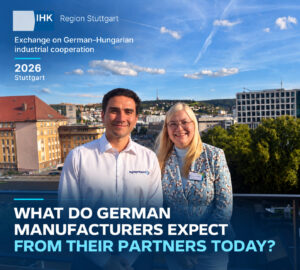
This question was one of the topics behind a recent discussion I had in Stuttgart with Barbara Effenberger at IHK Region Stuttgart.
For Synermont, discussions like this are important because Germany is one of our core markets.
We cannot develop the right manufacturing model simply by deciding what we want to sell.
We need to understand what German manufacturers actually need.
German Manufacturing Is Becoming More International – But Not Simply for Market Expansion
International manufacturing has always played an important role for German industry.
But the motivation behind foreign investment is changing.
According to the DIHK’s 2026 survey of around 1,700 German industrial companies, 43% planned investments abroad.
Cost pressure has become particularly important.
Among industrial companies planning foreign investment, 41% cited cost savings as their main motive – the highest level since 2003. DIHK
This is an important signal.
But it would be too simplistic to conclude that German manufacturers are simply looking for cheaper countries.
Manufacturing decisions involve much more than labour costs.
They involve:
- quality,
- reliability,
- logistics,
- flexibility,
- communication,
- industrialization,
- capacity,
- supply-chain risk,
- investment,
- transparency,
- and control.
The lowest production price does not automatically create the best manufacturing business case.
Europe Is Becoming More Important Again
The international environment is also changing.
Baden-Württemberg remains one of Europe’s most internationally connected industrial regions.
Recent trade data shows an interesting development: in the first half of 2026, Baden-Württemberg’s exports to European countries increased by almost 9%, while exports to the United States declined by almost 5%. IHK
IHK Region Stuttgart also reports increasing importance of European countries as both sales and sourcing markets. IHK
This does not mean that European sourcing will replace global sourcing.
Global manufacturing networks will remain important.
But it strengthens the strategic relevance of another question:
Which production processes can be organized competitively within Europe?
For German manufacturers, this can open opportunities to combine cost competitiveness with geographic proximity, shorter communication paths and stronger operational transparency.
What German Manufacturers Should Expect from a Manufacturing Partner
A strong international manufacturing partnership should provide more than production capacity.
Several factors are particularly important.
- Reliability
Reliability is the foundation.
A manufacturing partner needs to deliver:
- consistent quality,
- agreed quantities,
- predictable lead times,
- stable processes,
- and transparent communication.
Cost advantages quickly disappear when unreliable production creates additional internal work, quality problems or delivery disruptions.
- Quality Management
German manufacturing companies typically operate within clearly defined quality systems.
An international manufacturing partner therefore needs more than operators and production space.
It needs:
- documented processes,
- quality planning,
- traceability where required,
- inspection systems,
- structured corrective actions,
- and continuous improvement.
Quality should be built into the manufacturing process rather than added only through final inspection.
- Transparent Communication
Distance becomes a problem when communication is poor.
It becomes much less important when information flows transparently.
German manufacturers should therefore expect clear communication regarding:
- production status,
- capacity,
- quality,
- material availability,
- deviations,
- delivery,
- and corrective actions.
Problems should be communicated early rather than hidden.
Transparency creates control.
- Manufacturing Flexibility
Demand is rarely completely stable.
Product volumes change.
New variants appear.
Projects ramp up.
Some products decline.
Unexpected capacity requirements emerge.
A manufacturing partner should therefore be able to support changing production requirements without forcing the customer into an unnecessarily rigid structure.
This can include:
- flexible workforce,
- scalable capacity,
- pilot production,
- pre-series production,
- serial production,
- and temporary capacity support.
Flexibility itself is becoming a manufacturing capability.
- Industrialization Capability
A drawing and a bill of materials are not always enough to create a stable serial-production process.
Manufacturing partners increasingly need to contribute to industrialization.
This can include:
- process design,
- workstation development,
- production layout,
- material flow,
- testing strategy,
- work instructions,
- operator training,
- FMEA support,
- ramp-up,
- and continuous process optimization.
The stronger the industrialization capability, the earlier the manufacturing partner can contribute value.
- Understanding the Customer’s Core Competencies
Good outsourcing does not mean outsourcing everything.
Manufacturers need to identify which capabilities are strategically important.
These may include:
- product development,
- engineering,
- intellectual property,
- critical technologies,
- strategic manufacturing processes,
- or customer-specific know-how.
A good manufacturing partner should understand and respect this boundary.
The objective is not maximum outsourcing.
The objective is the right allocation of responsibilities.
- Competitive Cost Structure
Cost still matters.
For labour-intensive manufacturing processes, differences between European production locations can be substantial.
A manufacturing partner in Central Europe can therefore potentially provide a different cost structure while maintaining production within the European manufacturing ecosystem.
But hourly labour cost alone should never determine the decision.
Companies should consider the total manufacturing business case, including:
- logistics,
- inventory,
- working capital,
- quality,
- travel,
- lead times,
- flexibility,
- management effort,
- and supply-chain risk.
- Proximity
Proximity is not only measured in kilometres.
Operational proximity means:
- similar business culture,
- manageable travel,
- compatible time zones,
- direct communication,
- European legal frameworks,
- and the ability to meet quickly when required.
For German manufacturers, Central European production can therefore offer a middle ground between domestic manufacturing and distant offshore sourcing.
Supplier or Manufacturing Partner?
There is an important difference between purchasing a component and building a manufacturing partnership.
A traditional supplier relationship may look like:
Drawing → Quotation → Purchase Order → Production → Delivery
A strategic manufacturing partnership can involve much more:
Requirements → Process Design → Industrialization → Pilot → Ramp-up → Serial Production → Continuous Improvement
This distinction becomes particularly relevant when outsourcing:
- complex assembly,
- labour-intensive processes,
- mechatronic production,
- electronics assembly,
- testing,
- packaging,
- or complete manufacturing steps.
The more responsibility transferred, the more important trust and transparency become.
How Can Manufacturers Outsource Without Losing Control?
One of the biggest concerns around outsourcing is control.
But outsourcing and control are not necessarily opposites.
Control can be maintained through:
- clearly defined responsibilities,
- agreed KPIs,
- regular reporting,
- transparent quality data,
- documented processes,
- customer audits,
- structured communication,
- and joint continuous improvement.
This is also the logic behind an Extended Workbench – or Verlängerte Werkbank – model.
The customer retains strategic know-how, product requirements and key decisions.
The manufacturing partner takes responsibility for clearly defined operational production activities.
The objective is:
Keep control of what is strategic. Delegate what can be operated more efficiently.
Why Market Presence Matters for Manufacturing Partners
There is another element that is often overlooked.
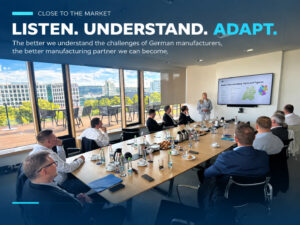
A manufacturing partner needs to understand the market it serves.
That cannot happen only through email, quotations and online meetings.
It requires direct contact.
Customer visits.
Factory discussions.
Industry events.
Technology exhibitions.
Industry organizations.
And conversations with the people who work directly with manufacturing companies.
This is one reason why spending time in Germany is important for us at Synermont.
Not simply to generate sales meetings.
But to understand:
Where is the pressure?
What is changing?
What are manufacturers struggling with?
What do they expect from their partners?
And where can we genuinely create value?
The better we understand these questions, the better we can develop our own manufacturing model.
German–Hungarian Manufacturing Cooperation
Hungary and Germany already have deeply established industrial relationships.
For future manufacturing partnerships, however, historical cooperation alone is not enough.
International manufacturing partners need to continuously demonstrate:
- professional operations,
- quality,
- reliability,
- competitiveness,
- communication,
- and technical capability.
The opportunity for Hungarian manufacturing companies is therefore not simply:
Hungary is cheaper.
That positioning is too narrow.
A stronger value proposition is:
competitive European manufacturing combined with professional industrial execution, flexibility and close cooperation.
That is a much more sustainable basis for German–Hungarian manufacturing partnerships.
The Right Partner Starts with the Right Questions
Before selecting an international manufacturing partner, manufacturers should ask:
Does the partner understand our manufacturing process?
Can they meet our quality requirements?
Can they support industrialization and ramp-up?
How transparent is production reporting?
How quickly can capacity be adjusted?
Which responsibilities remain with us?
Which responsibilities move to the partner?
How are problems communicated?
How is intellectual property protected?
What is the total manufacturing business case?
Can we realistically build a long-term working relationship with this company?
These questions often matter more than a small difference in unit price.
-> Read more about our services

