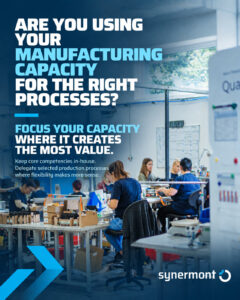
Are you using your manufacturing capacity for the right processes?
Manufacturing capacity is usually discussed as a quantity.
Do we have enough employees?
Do we have enough production space?
Do we need another production line?
Do we need to invest in additional equipment?
These are important questions.
But there is another question that can be even more important:
Are we using our existing manufacturing capacity for the processes where it creates the most value?
For European manufacturers facing high costs, investment pressure and uncertain demand, the answer can have a significant impact on competitiveness.
German manufacturers are cautious about adding capacity
Current German industrial investment data provides an interesting perspective.
According to the DIHK Economic Survey from February 2026, rationalisation was an investment motive for 43% of German industrial companies.
Product innovation was cited by 31%.
Capacity expansion was cited by only 20%.
DIHK noted that this was the lowest level for capacity expansion since the financial crisis.
The message should not be interpreted as evidence that German companies should outsource production.
But it does demonstrate something important:
Manufacturers are currently cautious about committing capital to additional permanent capacity.
In this environment, the way existing capacity is used becomes increasingly important.
Manufacturing capacity is more than machines
When companies talk about capacity, production equipment is often the first thing that comes to mind.
But manufacturing capacity includes much more.
It includes:
- skilled employees
- production space
- machines and equipment
- supervisors
- engineering support
- quality resources
- logistics
- management attention
- working capital
All of these resources have a cost.
More importantly, they also have an alternative use.
An engineer supporting a repetitive production problem cannot spend the same hour improving another process.
Production space occupied by one activity cannot simultaneously be used for another.
A production manager focused on daily capacity problems has less time available for industrialization, automation or continuous improvement.
This creates an opportunity cost.
Not every production hour creates the same strategic value
Two manufacturing processes can require similar internal resources while creating very different strategic value.
One process may contain proprietary technology, engineering know-how or critical product knowledge.
Another may consist primarily of repetitive manual assembly.
Both processes are necessary.
But they do not necessarily have the same strategic importance.
This distinction should influence how manufacturing capacity is allocated.
Internal capacity is particularly valuable when it supports processes that create competitive differentiation.
These can include:
- proprietary manufacturing technologies
- complex engineering processes
- critical quality capabilities
- product-specific know-how
- industrialization
- innovation
- strategically sensitive operations
These activities can justify significant internal resources because they contribute directly to the company’s competitive position.
Necessary does not always mean strategic
One of the most important distinctions in manufacturing strategy is between a process being necessary and a process being strategically differentiating.
Assembly is necessary.
Testing is necessary.
Packaging is necessary.
Rework may be necessary.
Many repetitive manufacturing operations are absolutely essential for delivering the final product.
But necessity alone does not automatically mean that the process must consume internal production capacity.
This is where make-or-buy decisions become relevant.
Start with strategic value
A make-or-buy analysis is often approached primarily through cost.
What does the process cost internally?
What would a supplier charge?
This comparison is necessary, but incomplete.
A broader analysis should also ask:
How much strategic value does this process create internally?
If the process contains proprietary know-how or provides important competitive differentiation, maintaining internal control may be essential.
If the process is standardized, labour-intensive and transferable, the strategic value of performing it internally may be lower.
This does not automatically mean that it should be outsourced.
It means that it deserves a different evaluation.
The hidden cost of internal capacity
Internal manufacturing capacity has several costs that are not always visible in a simple hourly calculation.
Additional volume may require:
- recruiting
- training
- additional production space
- new equipment
- supervision
- quality resources
- inventory
- maintenance
- management capacity
If demand remains stable for many years, investing in this capacity may be the correct decision.
But if demand fluctuates, the same investment can create underutilized fixed capacity.
This is particularly relevant for labour-intensive production processes.
The question therefore becomes:
Do we need more permanent capacity – or do we need access to more flexible capacity?
Flexible external capacity as part of the manufacturing system
Contract manufacturing provides one possible answer.
Selected production processes can be performed by an external manufacturing partner while strategically important capabilities remain internal.
This creates a hybrid manufacturing model.
The manufacturer retains control over the processes that create the greatest strategic value while using external capacity for selected operations.
Suitable processes may include:
- manual assembly
- pre-assembly
- electronics assembly
- testing
- inspection
- rework
- packaging
- selected production support
- temporary capacity requirements
The objective is not to outsource as much manufacturing as possible.
The objective is to allocate each process to the production structure where it makes the most strategic and economic sense.
European manufacturing creates different capacity options
For German and Austrian manufacturers, external manufacturing capacity does not necessarily mean moving production to another continent.
Europe itself contains significantly different manufacturing environments, cost structures and available capacities.
This makes it possible to create European manufacturing networks in which different locations perform different roles.
Engineering, product development and strategically critical processes may remain close to the company’s headquarters.
Selected labour-intensive or capacity-sensitive production processes can be performed by qualified manufacturing partners elsewhere within the EU.
The result can be a production footprint that combines:
- strategic control
- European proximity
- flexible capacity
- competitive cost structures
- shorter supply chains
- common regulatory frameworks
This is not simply outsourcing.
It is manufacturing architecture.
Rationalisation does not always mean automation
When manufacturers discuss rationalisation, automation is often one of the first solutions considered.
And in many processes, automation is clearly the right answer.
But not every production process can be economically automated.
Volumes may be too low.
Product variants may be too high.
Processes may change frequently.
Investment payback may be insufficient.
Manual work may remain the technically or economically more appropriate solution.
In these situations, the strategic question changes.
Instead of asking only:
How can we automate this process?
companies can also ask:
Where should this process be performed?
This can open another path toward manufacturing optimization.
Use internal capacity where it creates the most value
At Synermont, we see contract manufacturing as part of this broader manufacturing strategy.
From our production locations in Hungary, we support European manufacturing companies with selected outsourced production processes, including product assembly, electronics assembly, testing, packaging, production support and ramp-up.
The objective is not to replace the customer’s manufacturing organization.
It is to complement it.
The customer retains the capabilities that are strategically important, while selected processes can be performed through external European manufacturing capacity.
For manufacturers facing investment pressure, this creates an alternative to simply adding more permanent internal resources.
The key question is therefore not always:
How much manufacturing capacity do we have?
Sometimes the more important question is:
Are we using our most valuable manufacturing capacity for the processes where it creates the most value?
-> Read more about our services

