Should the process fit the factory – or the factory fit the process?
When transferring a production process to a manufacturing partner, there is an important question to consider:
Should the process be adapted to the available production environment, or should the production environment be designed around the process?
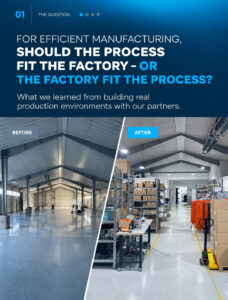
There is no universal answer for every manufacturing project. Existing equipment, infrastructure, investment requirements and technical constraints always matter.
But a production transfer creates an important opportunity: to reconsider how the manufacturing environment can best support the process.
A production transfer is more than moving production
Outsourcing production does not simply mean moving materials, equipment and work instructions from one location to another.
A successful transfer also requires understanding what makes the existing process work.
Which product characteristics are critical?
Which manufacturing steps require specific know-how?
Where are the quality risks?
How should materials move?
Which infrastructure is necessary?
What happens when volumes increase?
These questions should influence the design of the new production environment.
Start with product and process know-how
The customer normally brings the deepest knowledge of the product.
This includes product-specific technology, previous manufacturing experience, critical quality characteristics and lessons learned from existing production.
This knowledge should not disappear during outsourcing.
It forms the foundation of the transferred manufacturing process.
But it is only one side of the new production system.
Add manufacturing and industrialization know-how
The manufacturing partner brings a different type of expertise.
This can include industrialization, production layout, workstation design, material flow, infrastructure, internal logistics, production organization and scalability.
The objective is not to replace the customer’s existing know-how.
It is to combine both perspectives.
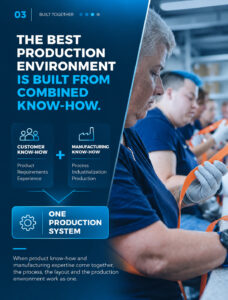
Customer know-how + manufacturing know-how can create a stronger production system.
Design the environment around what production needs
Once both sides understand the manufacturing requirements, the physical production environment can be developed.
Layout should support the process.
Workstations should support the manufacturing steps.
Material flow should reduce unnecessary handling.
Infrastructure should support equipment and production requirements.
Quality controls should be integrated where they are needed.
Storage and internal logistics should support production volumes.
Future capacity requirements should also be considered where relevant.
The factory therefore becomes more than a location.
It becomes part of the production system.
Do not copy blindly
Production transfer does not automatically mean that an existing setup should be redesigned.
Processes that work reliably should not be changed simply for the sake of change.
Product-specific know-how and proven manufacturing methods must be preserved.
However, transferring production to a new environment provides an opportunity to ask an important question:
Which elements should be copied – and which elements can be improved?
This is where cooperation between the customer and manufacturing partner becomes particularly valuable.
Build the production system together
At Synermont, production projects are developed through structured phases including needs assessment, manufacturing planning, project kick-off, industrial site development, ramp-up and serial production.
The purpose is not simply to create available manufacturing space.
It is to develop the people, infrastructure and production environment required by the manufacturing process.
The customer contributes product and process expertise.
The manufacturing partner contributes industrialization and operational expertise.
The strongest result comes when these two knowledge bases work together.
Because the best production setup is not necessarily the one that is copied most accurately.
It is the one that is built around what the process actually needs.
-> Read more about our services

